The Ukrainian language situation in Ukraine and in the world
How many people speak Ukrainian today? What languages do people speak in Ukraine? Where else is Ukrainian spoken? Read this post to find out what the Ukrainian language situation is like and how it has been changing in the course of history.
How many people in the world speak Ukrainian?
The estimations differ for several reasons (e.g. emigration, the bilingual situation in Ukraine), but it is generally accepted that there are up to 35-40 mln people in the world who speak (or at least understand) Ukrainian. That puts Ukrainian in the 25th place in the world by the number of speakers. If we are talking about Slavic languages, Russian is in the 8th place, Polish is in the 24th place by the number of speakers. So, Ukrainian is the 3rd most widely-spoken Slavic language in the world after Russian and Polish.
How many people in Ukraine speak Ukrainian?
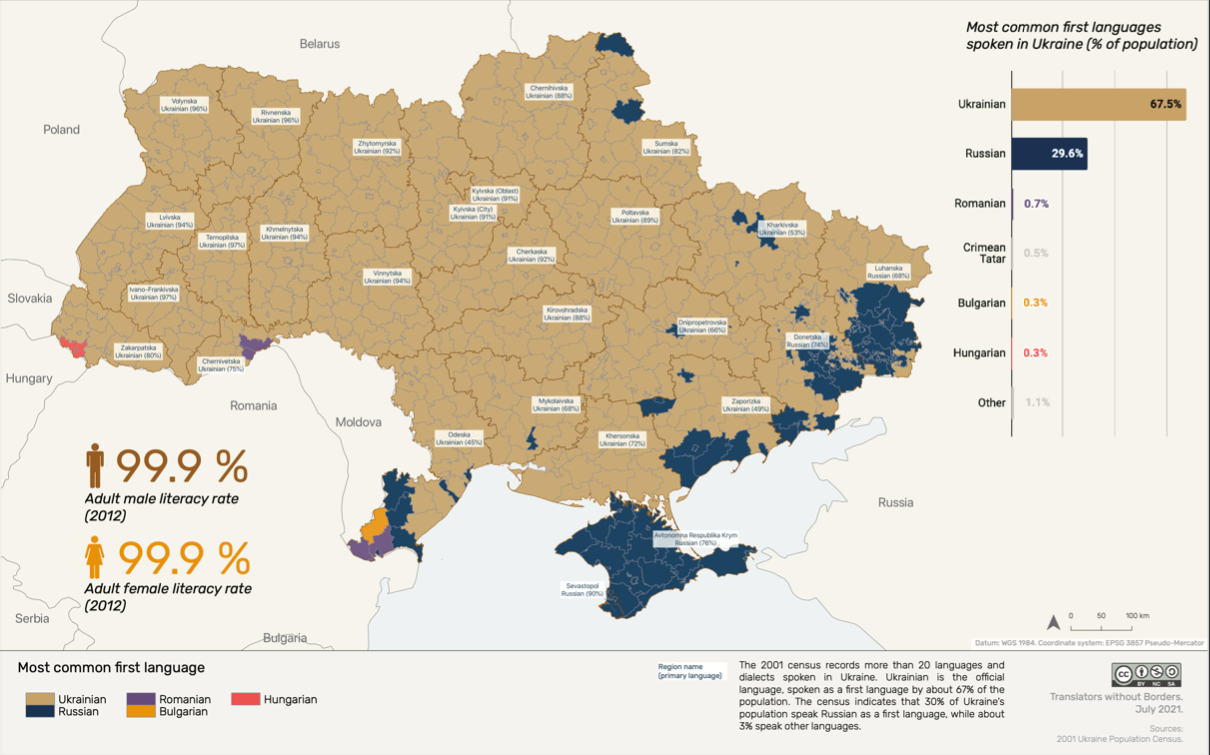
This Ukrainian language map is great to illustrate the language situation in Ukraine. As we can see, over 80% of people in Ukraine speak Ukrainian, with the exception of three regions. Dark-blue patches are places where people claim to speak Russian as their first language – 76% in Crimea, 74% in Donetska oblast, and 68% in Luhanska oblast.
What other languages (besides Ukrainian and Russian) are spoken in Ukraine? Purple in Odeska and Chernivetska regions is for Romanian as the first language. Yellow stands for Bulgarian as the first language, it is in Odeska oblast. Orange is for Hungarian as the first language in Zakarpatska oblast.
As for Ukrainian-speaking regions, we can rate them in a following way:
How many people in each Ukrainian region (oblast) speak Ukrainian?
(In brackets, you see the oblast central city)
97% Ivano-Frankivska oblast (Ivano-Frankivsk), Ternopilska oblast (Ternopil)
96% Volynska oblast (Lutsk), Rivnenska oblast (Rivne)
94% Lvivska oblast (Lviv), Khmelnytska oblast (Khmelnytskyi), Vinnytska oblast (Vinnytsia)
92% Zhytomyrska oblast (Zhytomyr), Cherkaska oblast (Cherkasy)
91% Kyivska oblast (Kyiv)
89% Poltavska oblast (Poltava)
88% Kirovohradska (Kropyvnytskyi) oblast, Chernihivska oblast (Chernihiv)
82% Sumska oblast (Sumy)
80% Zakarpatska oblast (Uzhorod)
75% Chernivetska oblast (Chernivtsi)
72% Khersonska oblast (Kherson)
68% Mykolaivska oblast (Mykolaiv)
66% Dnipropetrovska oblast (Dnipro City)
53% Kharkivska oblast (Kharkiv)
49% Zaporizka oblast (Zaporizzhia)
45% Odeska oblast (Odesa)
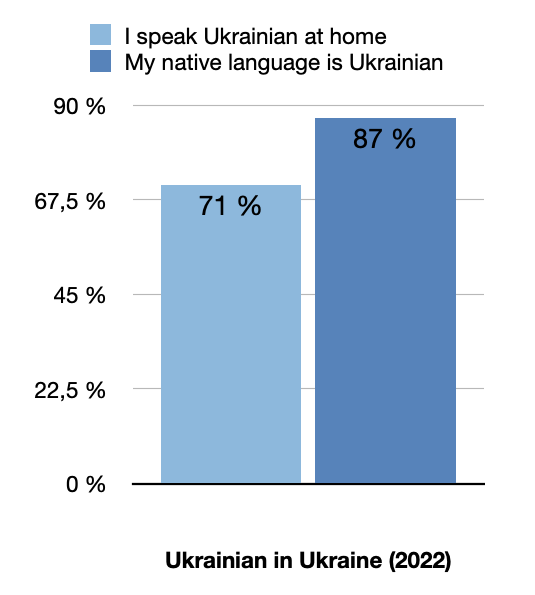
In 2022, 71% of Ukrainians spoke Ukrainian at home and in their everyday life. However, as mentioned above, this number varies in different regions of Ukraine (due to historical reasons). In the west of the country 96% speak Ukrainian, in the central regions – 78%, in the east there are 40% of people who speak Ukrainian, and 35% speak Ukrainian in the south.
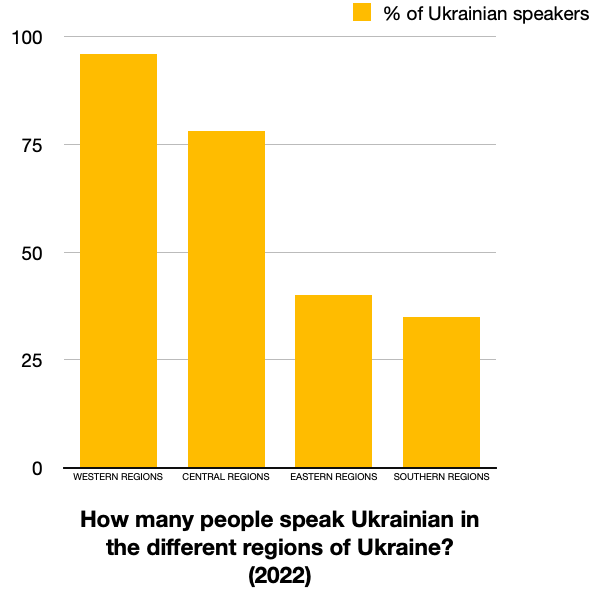
It means that in 2022, in the east about 47% of Ukrainian citizens speak Russian, and in the south, this number is 54.8%. However, we should note that even in the east and south, people still use Ukrainian in formal situations, e.g. when they write an application or take a school state graduation exam. In these regions, people speak Ukrainian more often if they live in a village and not in the city.
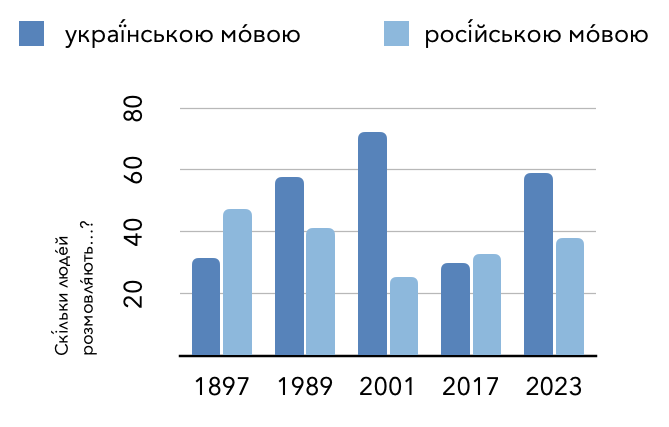
Let's see how the Ukrainian language situation has been changing in the capital of Ukraine – Kyiv. In 1897, at the time of the Russian Empire, 54% of people spoke Russian and 22% spoke Ukrainian in Kyiv. In 2023, according to polls, the language situation in Kyiv is the opposite – 59% of Kyivans speak Ukrainian at home, and 38% of them speak Russian.
If you ask a person, what their native language is, some of them would probably say that it is Ukrainian, even if they do speak Russian in everyday life. As you remember, 71% of Ukrainians speak Ukrainian, and 87% say Ukrainian is their native language. So, claiming Ukrainian to be your native language has to do more with a person’s identity than with the language they actually use to talk to their friends and family.
Here is an article about the language situation in Ukraine before the full-scale Russian invasion in 2022.
If you are interested in the modern state of things, here is a detailed video lecture about the language situation in Ukraine after the full-scale invasion in 2022.
It is reasonable to insert here a long quote from a recent book by Ukrainian historian Yaroslav Hrytsak "Overcoming the past: a global history of Ukraine" which extensively explains the complexity of the language issue in Ukraine:
...In the Russian Empire and the USSR, the Ukrainian language was subjected to systematic repression and pushed out of the public sphere. From this perspective, the Ukrainian case is similar to the Irish case. The difference was that, unlike the Irish language, Ukrainian did survive and remained the language of mass communication. One of the main factors was demographic: Ukrainians outnumbered the Irish, and neither state had enough resources to linguistically assimilate such a large population.
In the overall balance of the Russian and later Soviet empires, Ukrainians started out as Scots and ended up as Irish. Russian speakers in Ukraine are threatening to follow the same path - from loyalty to separatism - if their language is not granted the status of an official language. In fact, the issue is the preservation of monolingualism in the territory of their compact residence - the industrialised East and South of Ukraine. The irony of the situation is that if the residents of these regions really want bilingualism, they would have to learn Ukrainian!
The current linguistic situation in Ukraine is much more complicated than a simple division into Ukrainian and Russian speakers. A significant number of Ukrainians speak both Russian and Ukrainian, or a Russian-Ukrainian surzhik; linguistic separatism in Ukraine, with the exception of Crimea, has never been strong; even in the monolithically Russian-speaking Donetsk before the Russian-Ukrainian war, Russian identity was second to Ukrainian, and both together were third to Donetsk and the Soviet identity; the Donetsk elite went not from but to Kyiv in its quest for power, and there the most forward-thinking part of it tried to learn Ukrainian.
In independent Ukraine, language and identity are not clearly linked. Such a link exists among Ukrainian speakers, but not among Russian speakers: most of them consider themselves not to be Russians, but Ukrainians.
...The situation looks like a stalemate. Those who demand the status of Russian as a second official language threaten that otherwise Ukraine will fall apart. Those who are against it believe that Ukraine will fall apart precisely when Russian is granted this status.
Historically, Ukraine has never been monolingual and is unlikely to ever become so, at least in the near future. It is likely that over the coming decades it will become truly bilingual in the South and East. Trilingualism would be a good way to go, with English as a prerequisite for a successful career. Ukrainians may argue about a school language for their children. But they agree that English should be the second compulsory language.
One of the reasons why Russian has maintained a strong position in Ukraine is its status as a world language. Over the past two centuries, thanks to Russian state support, the development of Russian culture, and the export of communism, Russian has made the leap from a provincial European language to a world language. For many Ukrainians, Russian has been and to a large extent remains the language of entry into the larger world, and this is what makes it so attractive.
After the collapse of the USSR, Russian began to lose this status. According to forecasts, in 2025, Russian will be spoken by as few people as at the beginning of the 20th century, and it will not even be among the ten most widely spoken languages in the world. In Ukraine itself, as far back as 2000, the majority of citizens called Russian their main language of communication. But in 2002, the share of a Ukrainian language equaled that of Russian and has been growing steadily ever since, especially since 2014. This is due to demographic changes (the emergence of a generation of people the same age as Ukraine's independence) and the loss of Russian speakers from Donbas and Crimea. This process is also a consequence of the declining prestige of the Russian language...
...The language issue has become another ‘gift’ that the past has bestowed on modern Ukraine. It has deep historical roots, so it is unlikely to be resolved in the short term. Relying on the experience of other countries will do little good, simply because they had a different history. The general historical practice shows that language bans and repression are the least successful. They can push this issue under the surface for a while, but attempts to cover it with a tombstone are futile. The fate of the Catalan language under Franco or the fate of the Ukrainian language under the Russian Empire and the Soviet Union demonstrate this. On the other hand, liberal democracy offers a better chance of a more or less satisfactory solution, as it rejects any kind of linguistic discrimination. The big question is whether Ukraine will become a liberal democracy. It is moving in this direction, but even if it does, it will take a long time.
We need to learn to live with the language issue. It is like a chronic illness that is annoying, but from which no one dies. Today, however, this issue does not concern the Ukrainian language. It has become the official language, and there is no doubt about it. Just as there is no doubt about the special status of the language of the Crimean Tatars, the indigenous people of Ukraine. The language issue in Ukraine is primarily about the status of the Russian language. In its shortest terms, it can be formulated as follows: is the Russian language the language of the occupier or the historical heritage of Ukraine? Arguments can be found for both the first and second points of view. None of them can be proved or denied. Therefore, on the advice of the Ukrainian journalist and political scientist Yevhen Sereda, the conversation about language in Ukraine is best concluded with the words of Blaise Pascal: our greatness is not in sticking to one shore, but rather in standing on both, filling the space between them.
What is surzhyk?
It is also important to note that many people in Ukraine, even in historically Ukrainian-speaking regions, speak surzhyk. Surzhik is a mix of Ukrainian and Russian. Here's a video which breaks down this phenomenon:
For example, even in entirely Ukrainian-speaking Ternopil, you may hear it in a store: "Дайте, будь ласка, кілограм говядини" ("Please give me a kilogram of beef") instead of "Дайте, будь ласка, кілограм яловичини". "Говя́дина" ("говядіна", if to spell it with Ukrainian letters) is "beef" in Russian, and "я́ловичина" is "beef" in Ukrainian. Moreover, in Russian, this word is pronounced with an "i" sound after the "д", but Ukrainians will say the Ukrainian "и" sound here, pronouncing this Russian word with a Ukrainian accent.
Would you like to listen to more surzhyk and check if you can understand it? Here is a video in surzhyk (and about it):
This phenomenon is omnipresent. In some regions, especially in the south and east, there are a lot of Russian lexemes in people's speech, and in the west there are fewer, but they are still very present.
If you watch a video in Ukrainian with official subtitles added by journalists, you will see journalists replacing a word that a person said in surzhik with a literary Ukrainian word. So don't be surprised when you read something in the subtitles that is not what you actually heard with your own ears.
Sometimes people deliberately use Russian words, for example, for a mocking or joking effect. And sometimes they do so simply because they have "always said it that way." Unfortunately for foreigners, this creates challenges, because you often need to know two languages - Ukrainian and Russian - to understand what people are saying on the street in Ukraine, since the interference of Russian is quite strong even in historically Ukrainian-speaking regions.
There are many resources to teach Ukrainians to speak pure literary Ukrainian, for example, like this one:
What countries speak Ukrainian?
Ukrainian is the official language only in Ukraine. However, there is a large Ukrainian diaspora in the world. Economic instability and political reasons made some ethnic Ukrainians travel abroad.
At the end of the 19th century, 0.7 mln ethnic Ukrainians lived in the Russian Empire, 0.2 mln – in the Austro-Hungarian Empire, others moved to America and Canada.
Since the 1890s, Ukrainians started to immigrate to Brazil and Argentina.
Those who moved to the US and Canada started to gather around locally founded Greek Catholic churches. These Ukrainians, who had found themselves among strangers, wanted to keep their identity. Sometimes they were even more successful in doing that than the Ukrainians who stayed to live in their own country under the Soviets. They also created civil and political organizations to influence local politics in society in favor of Ukraine. They are still active, especially after 2014 when the Russian-Ukrainian war started, and the diaspora raised funds and awareness for Ukraine.
In the 1920s, people also started to move to Paraguay and Uruguay. Some Ukrainians managed to move to Western Europe (Czechoslovakia, Germany, Poland, France, Belgium, Great Britain, etc.).
After the World War II, Ukrainians massively moved to Germany and Austria (over 250,000 people), and even to Australia and New Zealand.
Ukrainians immigrated for different reasons, but one of the main reasons was that people, for whom the Ukrainian language, the Ukrainian identity, political freedom, and civil rights mattered, could not survive under the USSR. So, they moved to the West.
Every now and then, you may notice a «vintage sounding» of the Ukrainian language spoken in this historical Ukrainian diaspora. Why is that? It is because Ukrainian immigrants have preserved the language version their ancestors had brought from Ukraine (from the end of the 19th - at the beginning of the 20th century in particular, from the western part of the country).
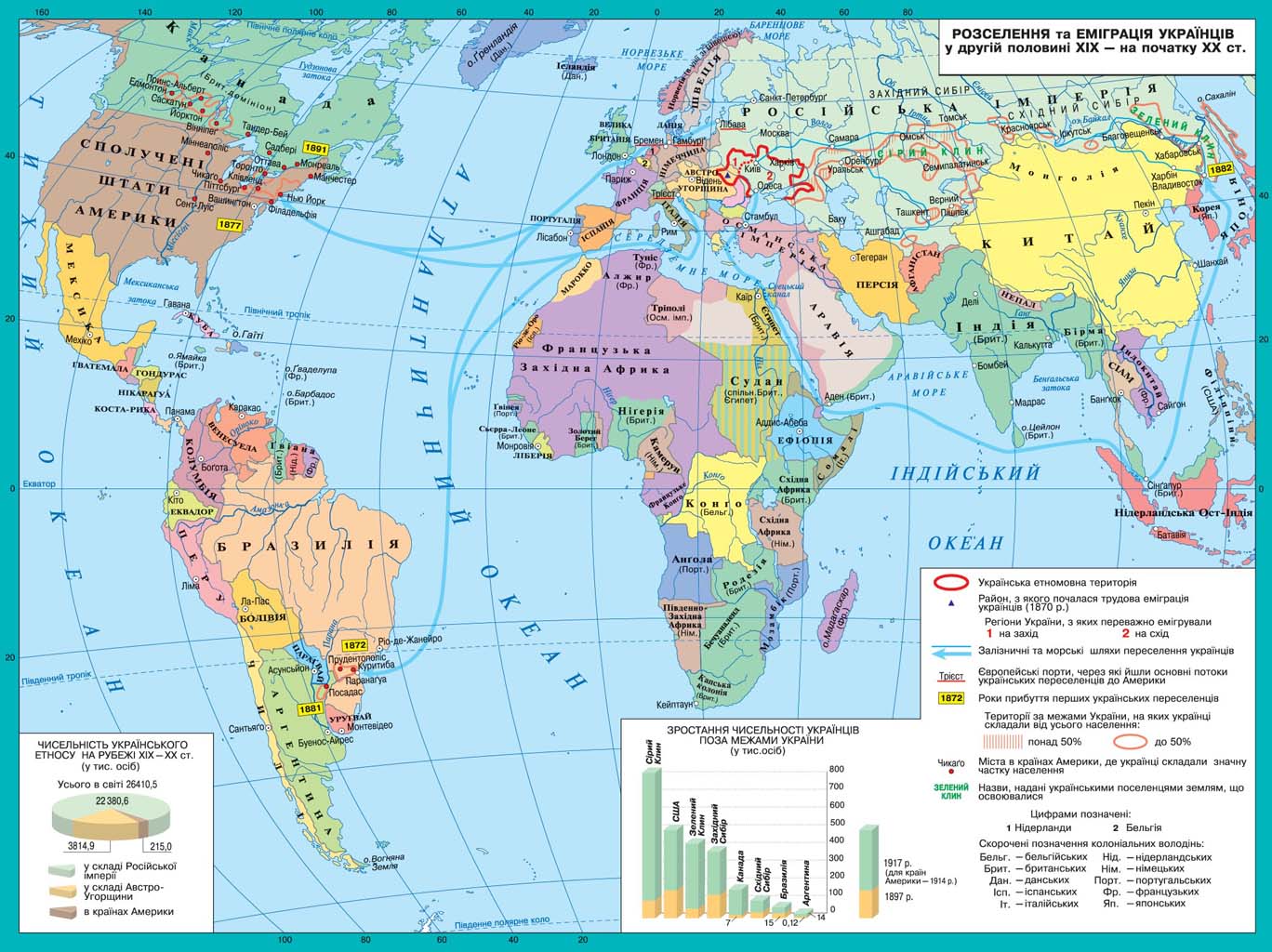
This map shows what countries Ukrainian moved to at the end of the 19th - at the beginning of the 20th century.
Later, since 1991 when an independent Ukrainian state started to exist, Ukrainians continued to immigrate for economic reasons, but those immigrants were different. The Ukrainian language was not as important to them.
So, nowadays, we can hear Ukrainian in Ukraine and in other countries with a high percentage of Ukrainian immigrants. Traditionally, these countries are the USA and Canada, Brazil and Argentina, Germany, Poland, the UK, Italy, France, Spain, Portugal, Greece, the Czech Republic, Australia, and others. In these countries, you can find Ukrainian shops, Sunday schools, bookstores or local media.
After the 24th of February 2022 (the beginning of the Russian full-scale invasion), you may meet Ukrainian-speaking people in many more countries.
If you are looking for courses or lessons to learn Ukrainian online, check out what I offer. You can also scroll through my blog to find teacher's tips on Ukrainian learning. And, please, join our community where we learn Ukrainian together and where you can ask questions.