What is Ukrainian like?
Many people wonder if Ukrainian is almost the same as Russian. Some think that Ukrainian is as different from English as Chinese or Japanese. Others have heard that Ukrainian grammar is incomprehensible and the alphabet is weird. And a lot of learners do not dare to start with Ukrainian because they can't imagine how long it takes for an English-speaking person to become fluent. But what is Ukrainian really like? Let us find out.
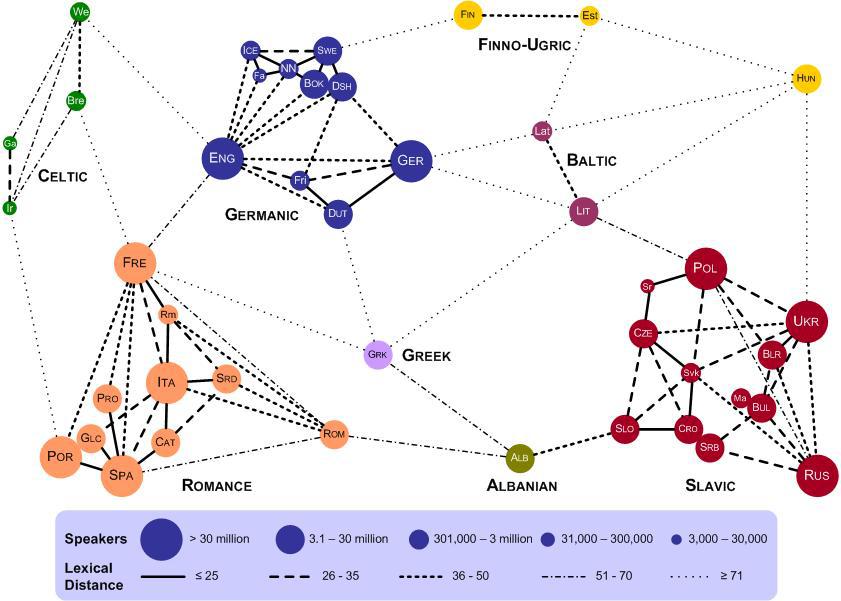
Ukrainian is a language from the Slavic language group. It belongs to the Indo-European group of languages. It is close to Belarusian, Polish, Czech, Slovakian, Serbian, and only then Russian. Look at this picture to see what languages Ukrainian is related to (Ukrainian is the red circle on the far right).
IS UKRAINIAN SIMILAR TO RUSSIAN?
Here is a good article demonstrating the differences between Ukrainian and Russian. I will quote part of it to answer the question, whether a Russian speaker can speak Ukrainian without learning it. The obvious answer is «no» since these are two separate languages. You might understand some Dutch if you speak German, but you cannot speak Dutch if you haven’t learned it. The same is true of Ukrainian and Russian.
38% of Ukrainian words are different from Russian. With grammar, the general concepts are identical – cases, verb tenses, etc. – but the word endings are different. Ukrainian is most similar to Belarusian, and Russian is closest to Bulgarian. Compared with European languages, Ukrainian and Russian are as similar as Spanish is to Italian or French to Portuguese.
So, if you want to speak Ukrainian, you have to learn it! Knowing Russian will, at best, only speed this process up. Check out my article on how to learn Ukrainian for free.
So no, Russians do not speak Ukrainian – but might understand it a little bit due to linguistic similarities. This can be explained by historical reasons. During the Russian (and Soviet) occupation of Ukraine, they imposed the Russian language and banned Ukrainian, but not vice versa. The situation can be roughly compared to some Indians speaking English but very few British speaking Hindi, or some Algerians speaking French but few French speaking Arabic or Berber.
I have a post about the history of the Ukrainian language, check it out if you want to know more. And in this post I explain a modern language situation in Ukraine.
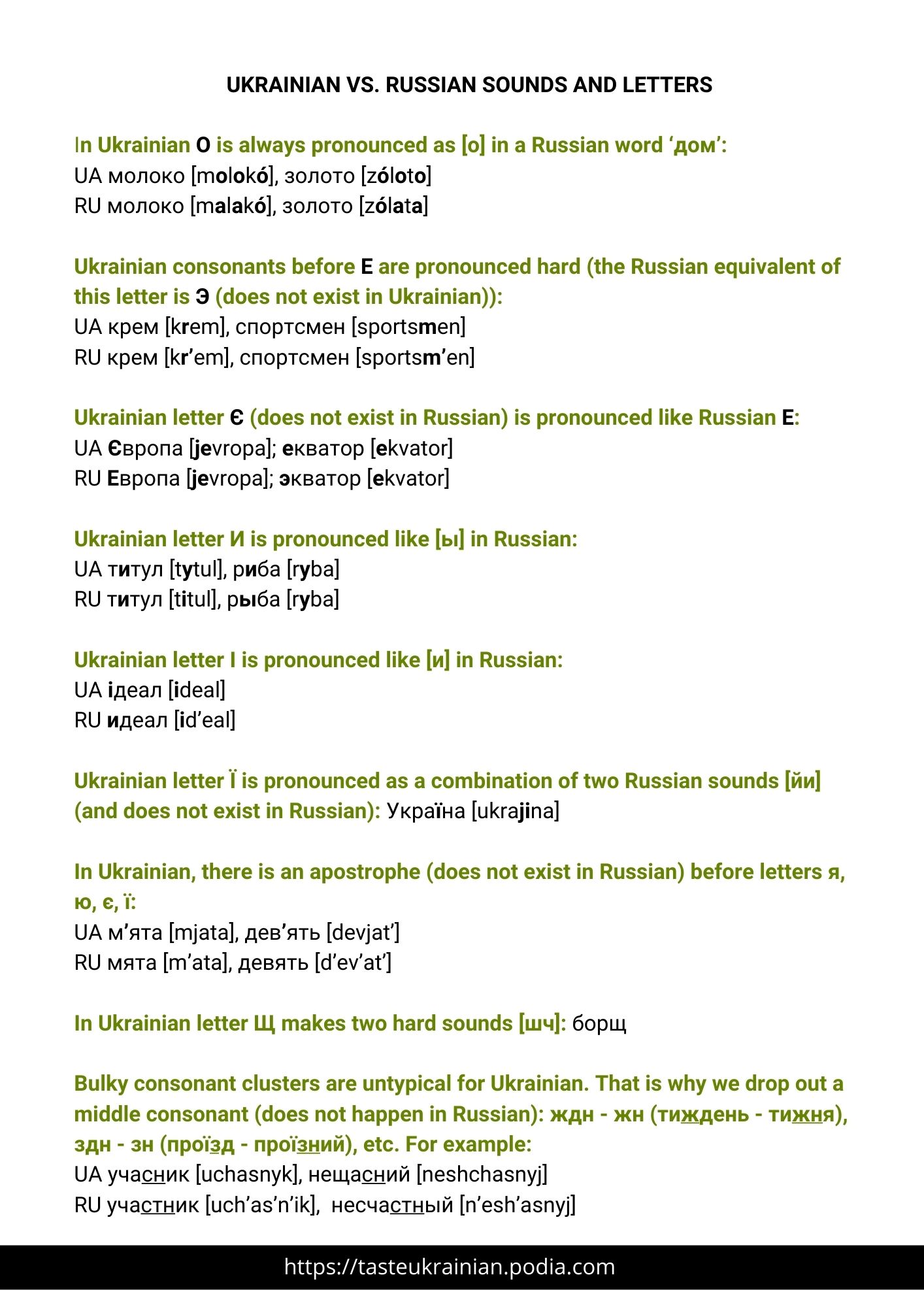
Let's compare Ukrainian and Russian sounds and letters (here's an audio version of this illustration):
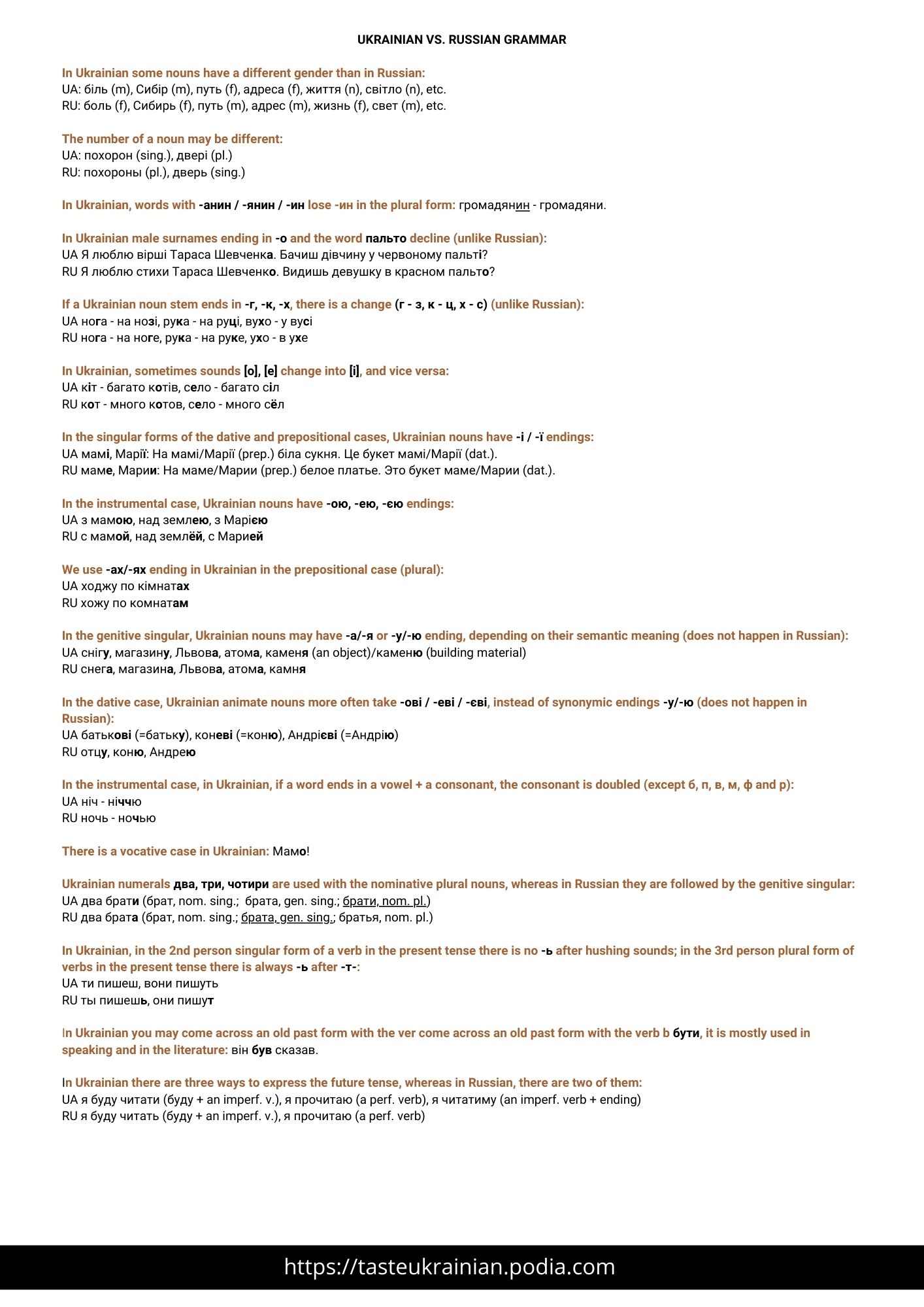
Let's compare Ukrainian and Russian grammar (the most important points of difference):
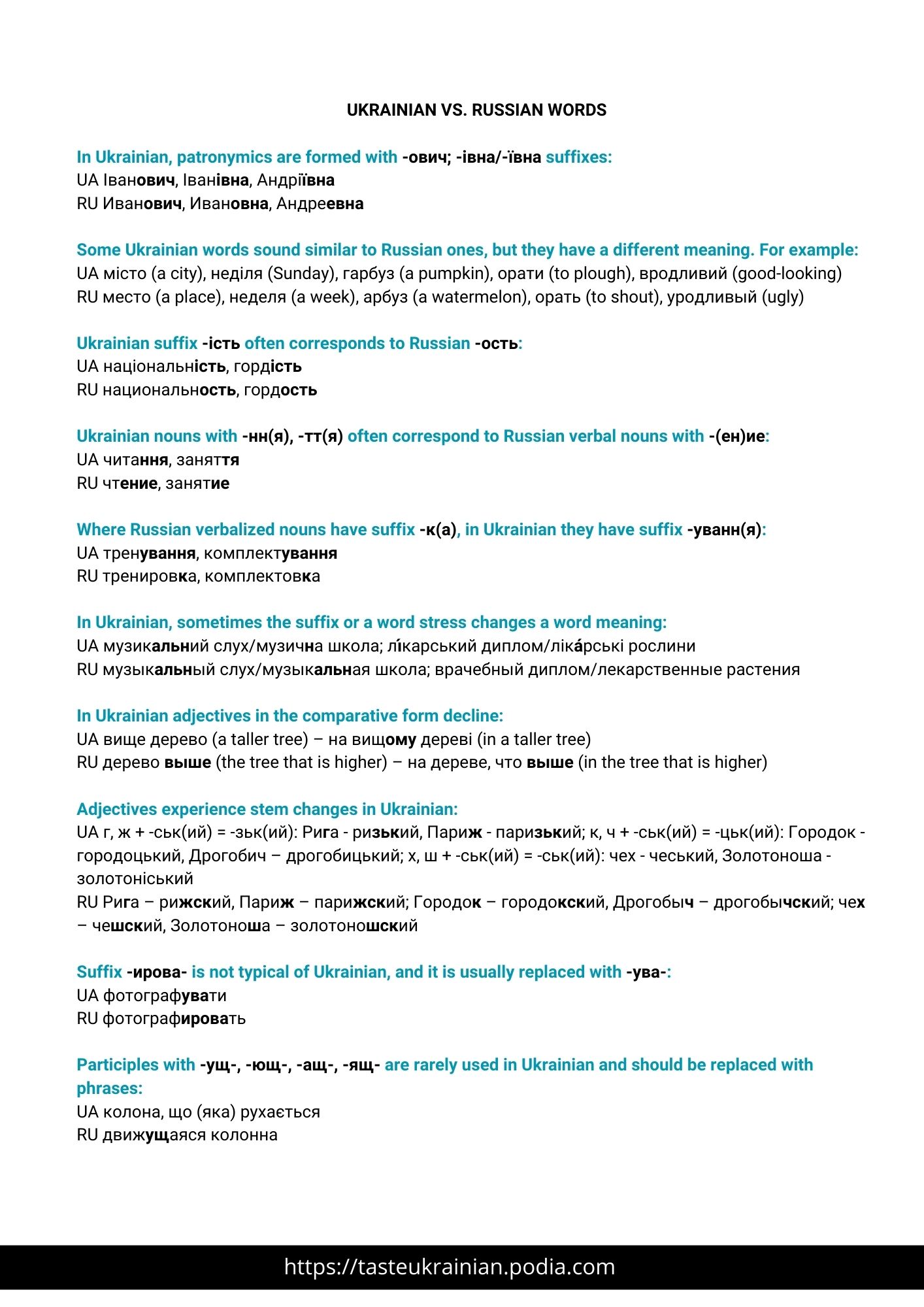
Finally, let's see how Ukrainian and Russian words differ:
This video gives you a detailed overview of how similar and different Ukrainian and Russian are:
THE UKRAINIAN ALPHABET
Ukrainian uses the Cyrillic alphabet (see below). Some letters look like Latin ones and sound the same (in blue), others look like Latin ones but sound differently (in red), and the remaining letters do not exist in the Latin alphabet.

A couple of fun facts about Ukrainian:
the most common initial letter for Ukrainian words is «п»;
the least used letter is «ф» (which occurs mostly in foreign words).
WHAT IS UKRAINIAN GRAMMAR LIKE?
Ukrainian is a synthetic language. It means that words change their endings when they are used in different roles in a sentence.
For example, here are all the forms of the word «президент»:
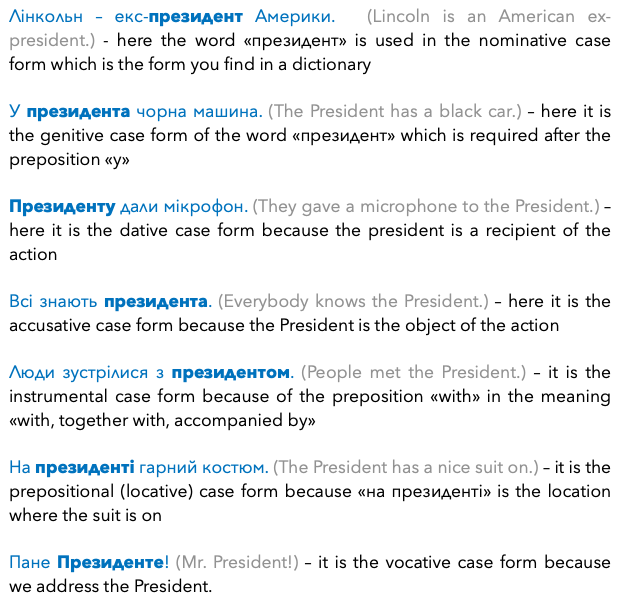
If you describe the President, the descriptive words will also change their endings, depending on the grammatical gender and number of the noun being described, as well as its role in a sentence.

Nouns and pronouns, numerals, adjectives, adverbs, and verbs change their endings when we want to show the relation between these words in a sentence, or when we want to demonstrate what their role is (the doer of the action, the recipient or the object of the action, etc.). It is different in English where we mostly use the word order for the same sake. Of course, in English, we also change the words when we want to make a singular word plural (e.g. a cat – cats), or when a different person performs an action («I read» but «he reads»), but these changes are not so numerous.
This means that in English you can learn ten food words and a couple of verbs and combine them to make lots of sentences. In Ukrainian the same is impossible because you need to know all the word forms to use a word freely. That is why if you want to speak Ukrainian and understand what people say to you, at first you have to learn the basic grammar, and only then build up your vocabulary. Let me illustrate this.
Here are some food words: яблуко (an apple), шоколад (chocolate), суп (soup), кава (coffee), сік (juice), їсти (to eat), любити (to like), є (there is/there are), немає (there is no/there are no). Here are the phrases I want to make in English and how I should translate them into Ukrainian:
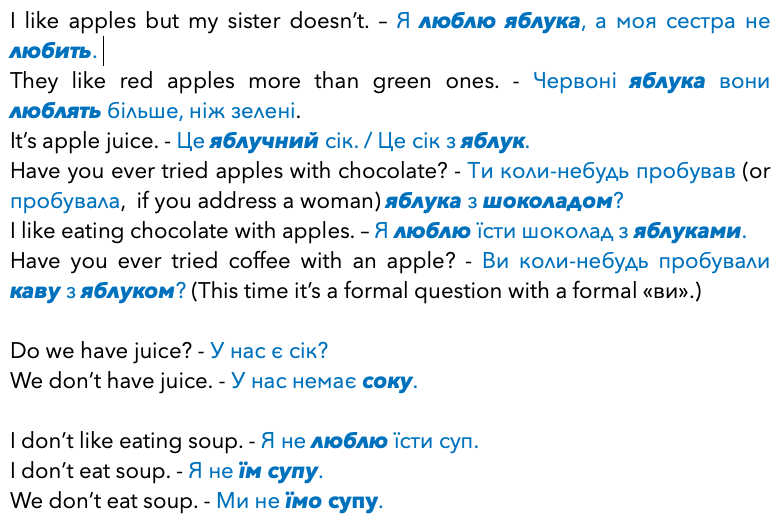
«Я люблю», «сестра любить», «вони люблять» is how the basic form «любити» changes, when you have different persons.
«Яблуко» becomes «яблука» when it’s plural. «З яблук» means «made of apples», it is the genitive plural. «З яблуками» means «with apples», it is the instrumental plural. But the instrumental singular will be «з яблуком».
The same is this one – «з шоколадом» (with chocolate), the instrumental singular.
«Сік» becomes «соку» (it is genitive singular) when you communicate the idea of the absence of something.
The genitive is also used in negations: «Я не їм супу»/«Ми не їмо супу».
«Кава» becomes «каву» when coffee is the object of the action.
«Їсти» (to eat), «їм» (I eat), and «їмо» (we eat) are different forms of the verb «to eat».
Looking at these examples, you can tell that just knowing the basic form of the word is not enough. You need to know the basic rules of combining these words. An English-speaking person needs about 1100 hours to become confident in Ukrainian. Of course, this evaluation is approximate, because if you have experience in learning any other foreign language, it would be easier for you. Having a good memory is another accelerator.
I have a free course that gives an overview of how Ukrainian nouns decline. Take it to summarize your knowledge about Ukrainian cases. If you need a more systematic overview of Ukrainian grammar, check out my course "Basic Ukrainian Grammar: Step By Step" with the first step for free.
HOW MANY WORDS ARE THERE IN UKRAINIAN?
Modern Ukrainian has over 250 thousand words. English has about twice more.
Ukrainian and Belarusian share 84% of the words. Ukrainian and Polish have 70% of the common words, and Ukrainian and Serbian – 68%. Ukrainian and Russian have 62% of common words.
Ukrainian has about 10% of loan words (compare that to English where 30% of words are loaned from French or to Japanese with about 70% of loan words mostly from Chinese).
Ukrainian has words from Greek and Latin (фізика, фігура, факт, демократія, факультет, психологія, бібліотека, космос), Turkish words (сарай, базар, баклажан, кавун, килим), Arabic ones (алгебра), words from French (бульйон, пляж), German words (дах, ландшафт), Dutch ones (гавань, краб), Italian words (піаніно, спагеті), words from Polish (пан, повидло, ґудзик), etc.
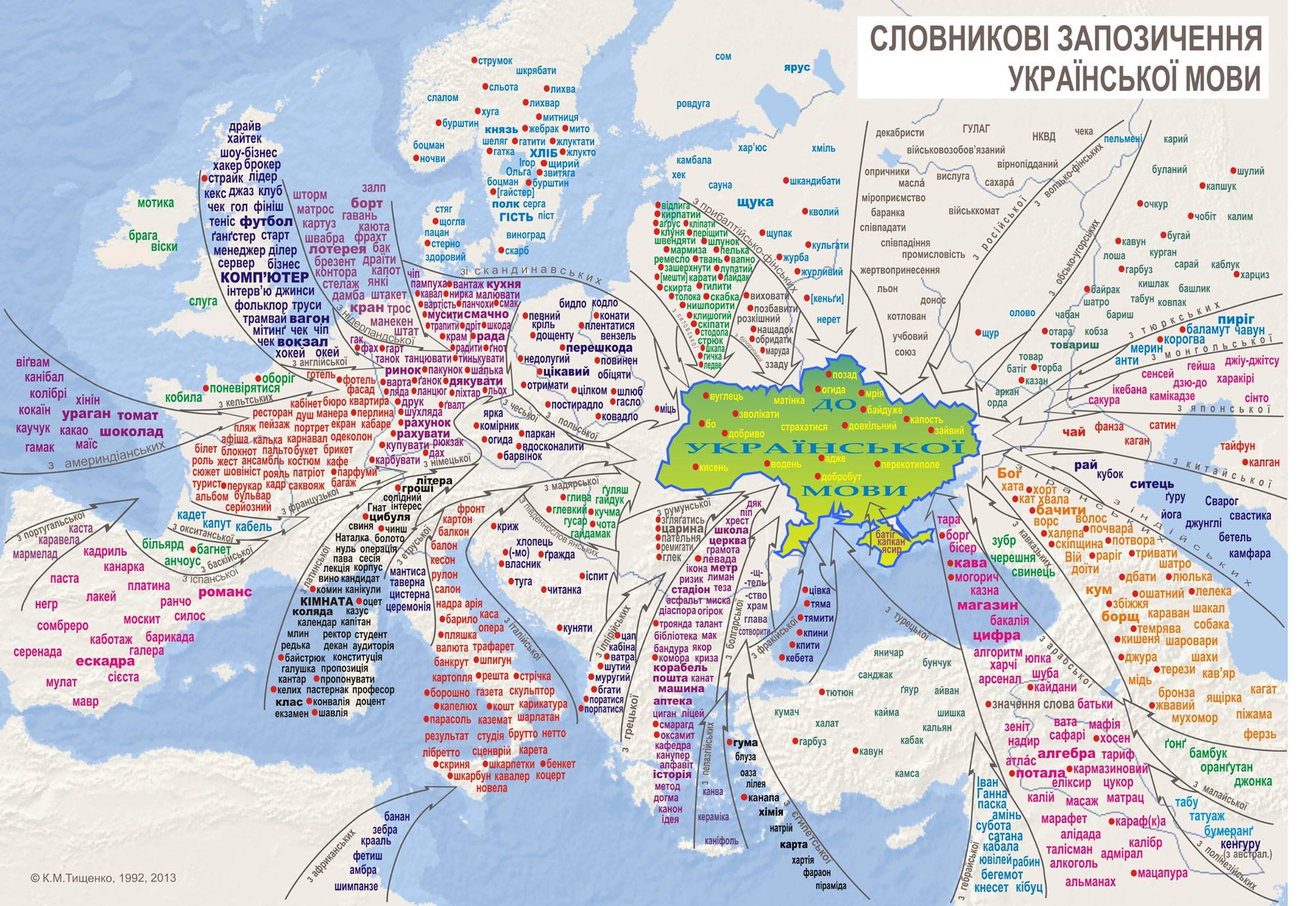
So, Ukrainian is close to Central and Eastern European languages but quite different from Western European, Asian or African languages. Probably that is what makes it so fun to learn.
If you want to know more about the history of Ukrainian, check out this article. There is also an extensive encyclopedia article about the Ukrainian language and its history in the Internet Encyclopedia of Ukraine.
Check the blog for more posts about Ukrainian. Go to courses, downloads or lessons if you need extra resources to learn Ukrainian. And join our community to share your thoughts about it all.