A detailed review of "Yabluko" textbooks
What are "Yabluko" textbooks like? Where can you order them? What is good and bad about them? An honest teacher's review of the most substantial and well-known Ukrainian course.
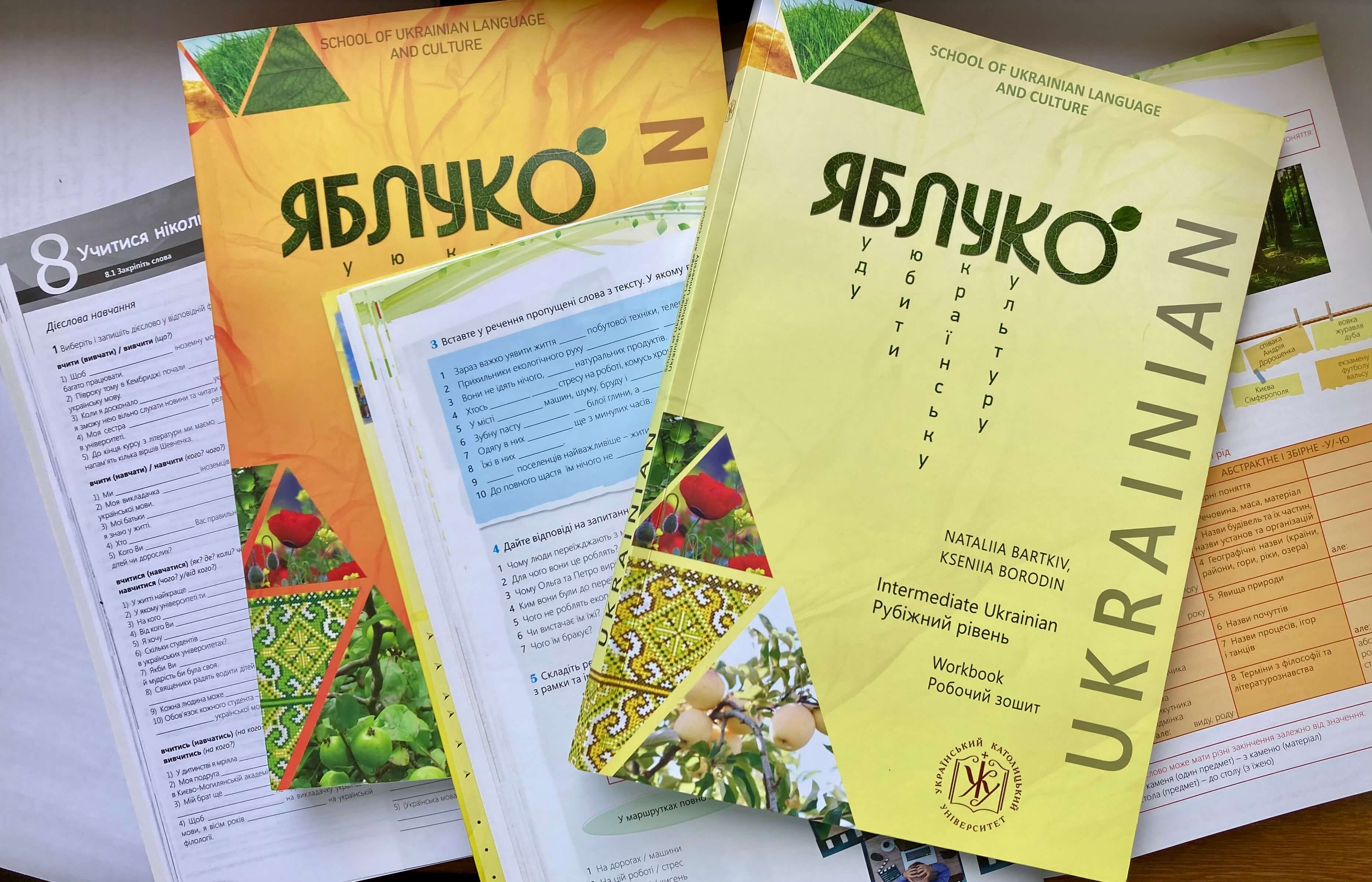
Where to order "Yabluko" books?
"Yabluko" course has been made by Ukrainian Catholic University – a private university in Lviv. They run the School of Ukrainian Language and Culture, where you may take live or online Ukrainian lessons. Their teachers have made "Yabluko".
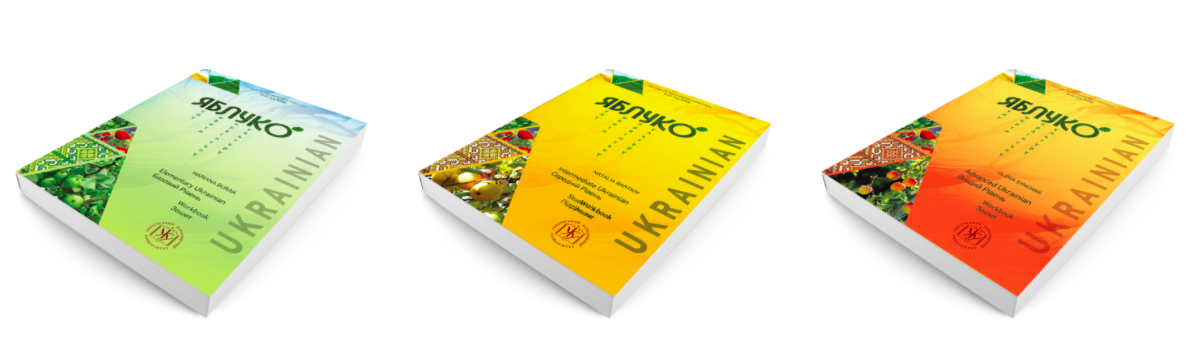
"Yabluko" is comprised of three levels:
green books for the elementary level (A2+ / B1)
yellow books for the intermediate level (B1-B2)
red books for the advanced level (C1+)
Each level includes a student's book (with coloured pages) and a workbook (with black and white pages).
You can order the books here.
What are "Yabluko" textbooks like?
The books are printed on heavy gloss paper, so they weigh quite a lot: 1.7 kg for an intermediate level and 1.5 kg – for an advanced level, especially student's books.
The layout is modern, with tons of bright illustrations. However, some students complain that in the "fill-in-the-gaps" type of exercises the blank space is too small, so you have to write in tiny letters to cram the words. Like here:

The Structure of Yabluko Course
(on the example of "Yabluko. Elementary Ukrainian")
A course consists of a student's book and a workbook.
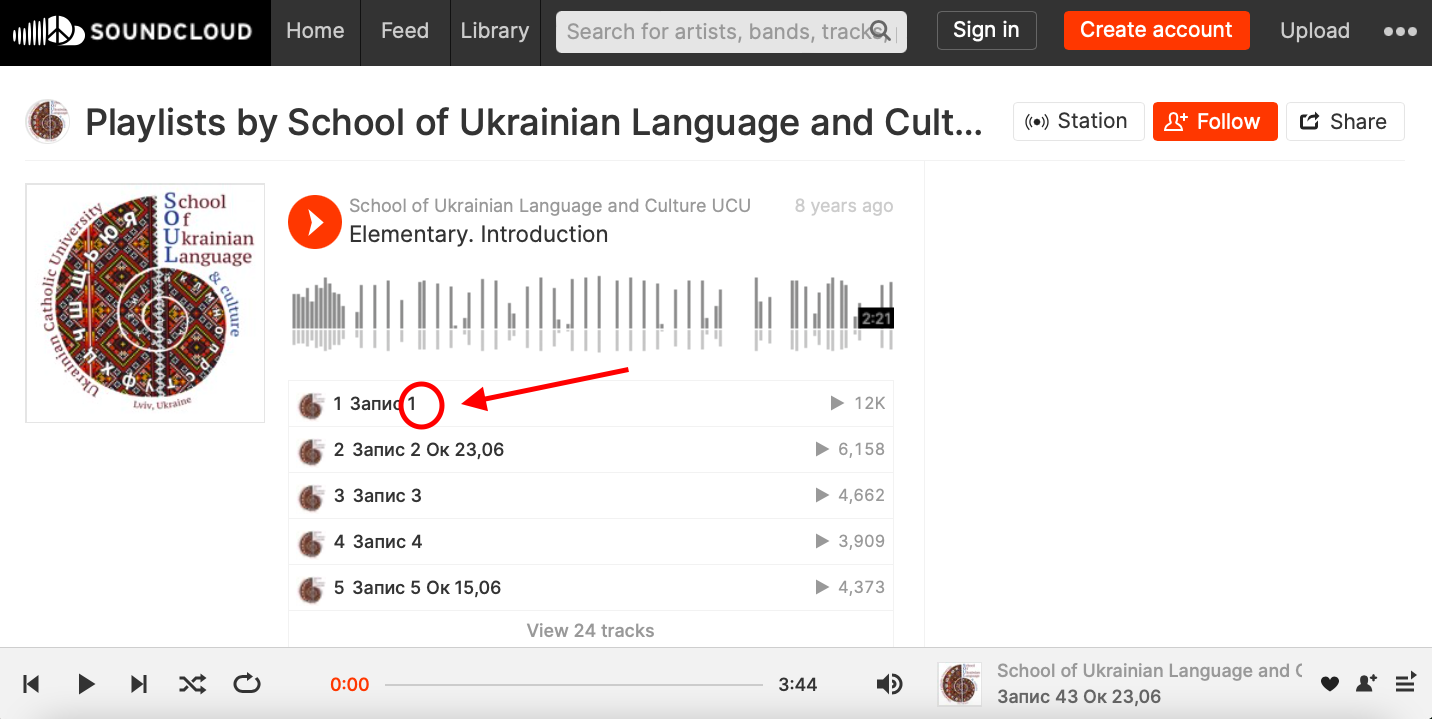
You can find audio files for the course on SoundCloud. If you need audios for the elementary level, scroll all the way down to "Elementary. Introduction". The number of the recording is the digit after the word "запис" ("recording"). At the end of the student's book, you may find the transcription of all the audio files.
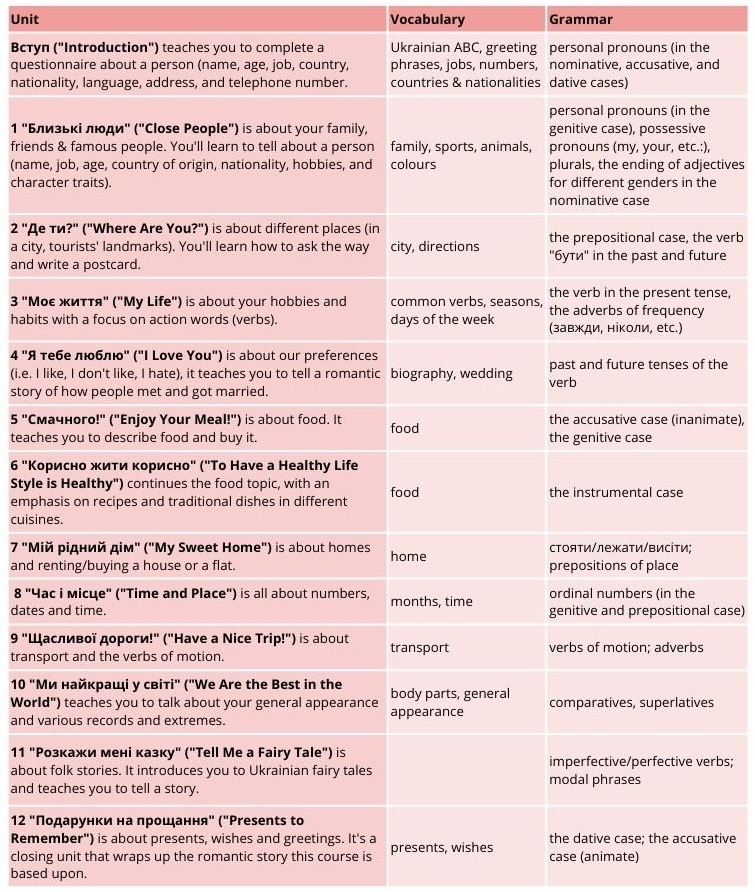
The course consists of 12 units (and an introduction). They cover various topics. See the table with the names of units, their vocabulary and grammar:
Each unit is comprised of seven lessons:
lesson 1: getting acquainted with the vocabulary of the unit
lesson 2: learning grammar
lesson 3: learning the Ukrainian culture
lesson 4: learning grammar
lesson 5: reading
lesson 6: speaking (diverse communicative situations)
lesson 7: writing
In the workbook, you find exercises to practice what you have learned in each one of the lessons. The number of the lesson in the workbook coincides with that in the student's book. For example, if you have covered Lesson 7.2 in the student's book, look for Lesson 7.2 in the workbook to practice everything learned.
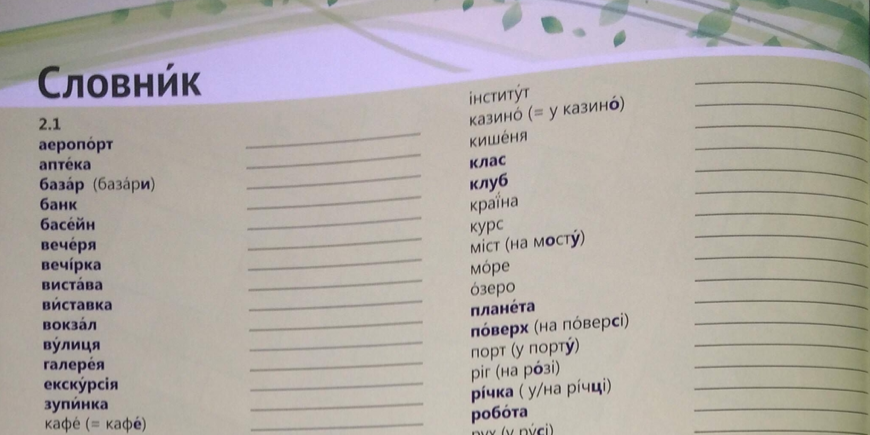
Each unit in the student's book concludes with a vocabulary list.
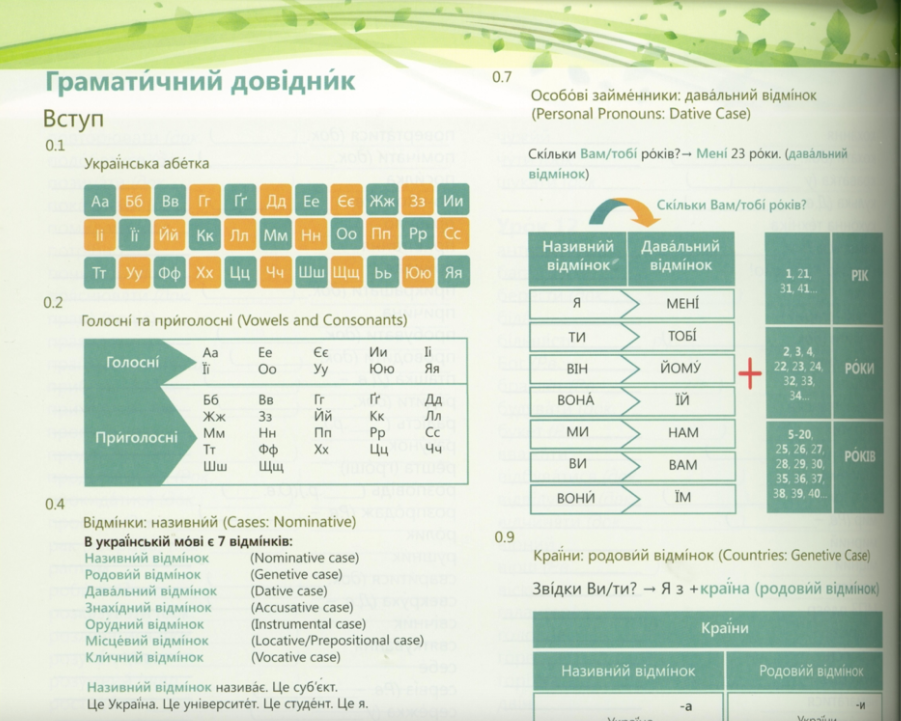
At the end of the student's book, there is a grammar guide with tables and explanations (alas, it is in Ukrainian).
How many hours do you need to complete one level?
It depends. But if one lesson usually takes you 45-60 min of classroom work plus 60-90 min of homework, then we have:
(45 min + 60 min) * 7 lessons in a unit ≈ 12 hours (for one unit)
12 hours * 12 units ≈ 144 hours (if to skip an introductory unit)
Some lessons will take you less, and some will take you more, but generally speaking, this course is designed for at least 150 hours of studying. If you dedicate to it three hours a week (e.g. on Monday, Wednesday, and Friday), you can complete it in 50 weeks – it is about a year. It is not recommended to learn less than three hours a week with longer breaks between days than a day or two because you will keep forgetting what you learned the last time, and you will start anew every time and waste time on revision instead of working with the new stuff.
This course has not been designed as a self-study one. Hence, it does not have keys. Also, it has a lot of open-ended questions and writing assignments where you need someone to talk to and correct you. Moreover, instructions and grammar explanations are in Ukrainian (and not English), which might be difficult for English-speaking beginners.
Who is this course for?
As for me, ideally, this course is:
for those who speak Russian or another Slavic language, or for those who have some experience with Ukrainian (at least, a completed Duolingo course), and for those who now want to systemize everything;
for those who are serious about Ukrainian and want to learn substantially;
for those who work a lot on their own – who look up every new word in the dictionary, draw grammar charts, make word flashcards, analyze and retell texts, etc.
What is particularly good about this course?
Modern layout with numerous bright illustrations.
It is substantial and exhaustive. There is plenty of material to select the relevant stuff from.
It is communicative: there is a lot to discuss, (dis)agree with and develop upon.
There is a lot of listening.
The texts (and audio) are not in a cookie-cutter style, they are saturated with words, spoken phrases and information. Moreover, there is a plot with two characters uniting all the lessons.
They teach you almost all the grammar right at the elementary level. So, straight away, you are given the tools to use when you create your own stories in Ukrainian (note: in Ukrainian, words change a lot, and to be fluent, you need to know ∼80% of grammar).
There are a lot of exercises to drill grammar which is important for such a "grammar-based" language as Ukrainian.
The course has a logical structure.
The course is a line of three levels, so a student can complete one level and easily switch to another one with the same structure, which is built on the previous grammar and vocabulary.
What to consider when you study by "Yabluko"?
The pace of the course
The pace increases from Unit 6 or 7. The first units operate with pretty simple grammar structures and a minimum of emotional/spoken phrases, but sentence structures become much more complicated in the second part of the book. The sentences get longer, and there are more new words in addition to the key vocabulary of the unit. And this change seems to be rather sudden.
Compare listening tasks from Unit 1, 3 & 6 to see how it gets more difficult:
Unit 1, Lesson 1.2, Exercise 7 (Recording 28), transcript:
Хочу розповісти вам про свою сім'ю. Мене звати Іван. Мені 35 років. І я одружений. У мене є дружина. Її звати Марія. Їй 33 роки. У нас є діти. Їх звати Назар та Зоряна. Зоряні 6 років. А Назару 4. У мене також є брат. Його звати Роман. І йому 38 років. Його дружині Оксані 33 роки. У них двоє дітей: син Андрій, йому 13 років, та дочка Марта, їй 12 років. У мене є батьки. Їх звати Марко та Юля. Моєму татові 68 років. А мамі 67 років. У мене є також дідусь та бабуся. Їх звати Петро та Галина. Вони дуже старенькі. Дідусеві 92 роки. А бабусі 89 років. Я дуже їх люблю!
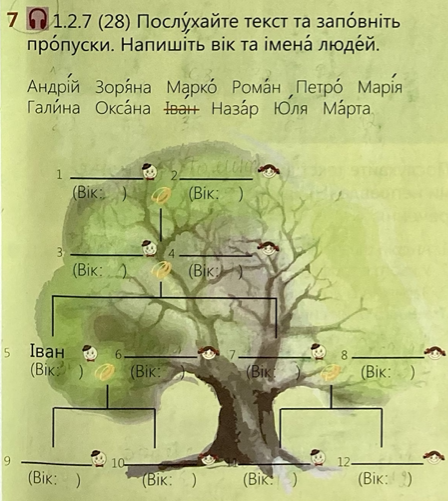
→ Sentences are short. The vocabulary is only the words from the unit. The task is to match names to age and their family role (a mother, a wife, a child, etc.) to complete the family tree.
Unit 3, Lesson 3.3, Exercise 9 (Recording 51), transcript:
Роман Васьків – середньостатистичний українець. Він живе у квартирі. Роман працює в Українському католицькому університеті. Він директор Школи української мови та культури. Вдома Роман розмовляє українською мовою, але він також знає російську, англійську та польську. Роман одружений. Його дружина Оксана також працює в Українському католицькому університеті. Добре, коли чоловік та дружина працюють разом. У них є дві донечки. Їх звати Андріана та Софійка. Старшій донечці Романа 9 років. Вона школярка. Молодша донечка Софійка ще зовсім маленька. Їй лише один рік. У будні дні Роман зазвичай працює вісім годин. Увечері вдома він допомагає сім'ї та проводить час із донечками. У суботу Роман та його сім'я прибирають у квартирі та їздять на природу. У неділю вони ходять до церкви та на прогулянки. Іноді у вихідні Роман та його дружина ходять у гості. Увесь час Роман живе у Львові, але він дуже любить подорожувати. Узимку він зазвичай їздить у Карпати і катається там на лижах. Улітку Роман багато працює на Літній школі української мови, але після її закінчення він та його сім'я завжди відпочивають у Карпатах.
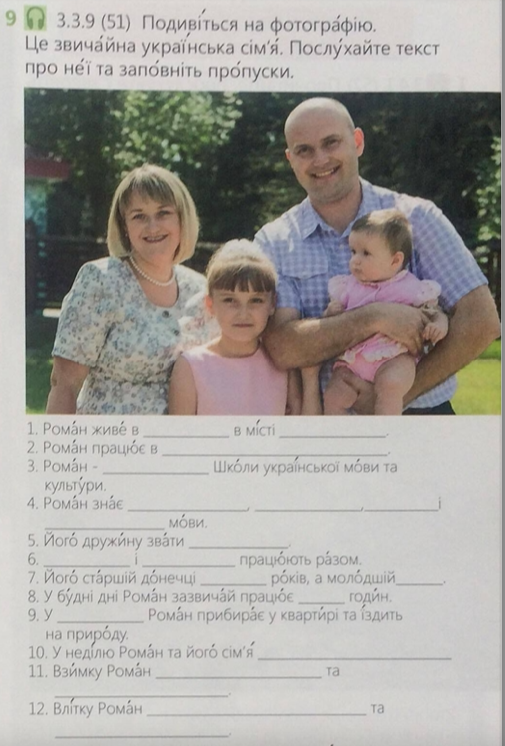
→ Sentences become longer. There are some words not from the unit (e.g. середньостатистичний, вдома, разом, ще, зовсім, допомагає сім'ї, проводить час, прибирають, їздять на природу, у гості, увесь час, після її закінчення; full and short names: Андріана (a full name), Софійка (a short form of Софія); proper names). The task is to complete the gaps, and it is doable because a student can read the sentences he or she is going to hear, and they will not sound overwhelming, even when they have quite a lot of new words.
Unit 6, Lesson 6.1, Exercise 3 (Recording 72), transcript:
Сьогодні ми вирішили запитати людей на вулиці, чи їдять вони шкідливу їжу.
– Доброго дня! Як вас звати, і хто ви?
– Мене звати Микола. Мені 19 років. Я студент університету.
– Скажіть, будь ласка, Миколо, ось, ми бачимо, що ви щойно купили хот-дог. До речі, смачного. Але чи знаєте ви, що хот-доги – це шкідлива їжа? Ви не боїтесь за своє здоров'я?
– Ні, зовсім ні. Я дуже люблю хот-доги та іншу швидку їжу. Наприклад, гамбургери та картоплю фрі. Ммм... Це все таке смачне!
– Але ж така їжа небезпечна для вашого здоров'я!
– Знаєте, життя – взагалі небезпечна річ. Зараз небезпечно ходити по вулиці, дихати, говорити по мобілці і навіть багато вчитись також небезпечно! Але всі це роблять. Таке життя.
– Тобто ви їсте шкідливу їжу, тому що вона смачна?
– Не тільки. Мені подобається, що вона досить дешева, її продають на кожному кроці, і її можна швидко замовити і з'їсти. Я ж студент і живу в гуртожитку. Моя мама далеко і не готує мені щодня свіжу їжу, а готувати самому – ні, дякую. У мене нема на це часу...
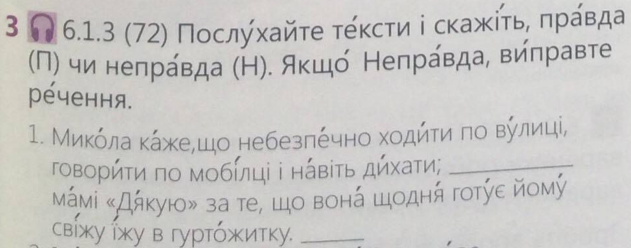
→ Here, you can see a lot of intermediate sentence structures (incomplete sentences, emphatic constructions, spoken words). And they ask a student not to just complete the gaps in the ready-made sentences or do the matching, but to understand the general idea of a person's words and evaluate/summarize them. Moreover, the task is phrased with the help of compound sentences which is by itself an intermediate level.
Here is how reading becomes more and more difficult. Compare two texts from Unit 2 & 7:
Unit 2, Lesson 2.5, Exercise 21:
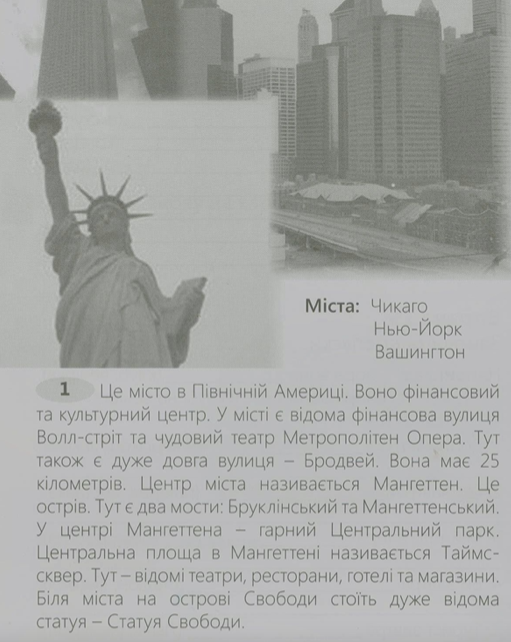
→ Simple short sentences, basic grammar, the vocabulary is from the unit.
Unit 7, Lesson 7.3, Exercise 9:
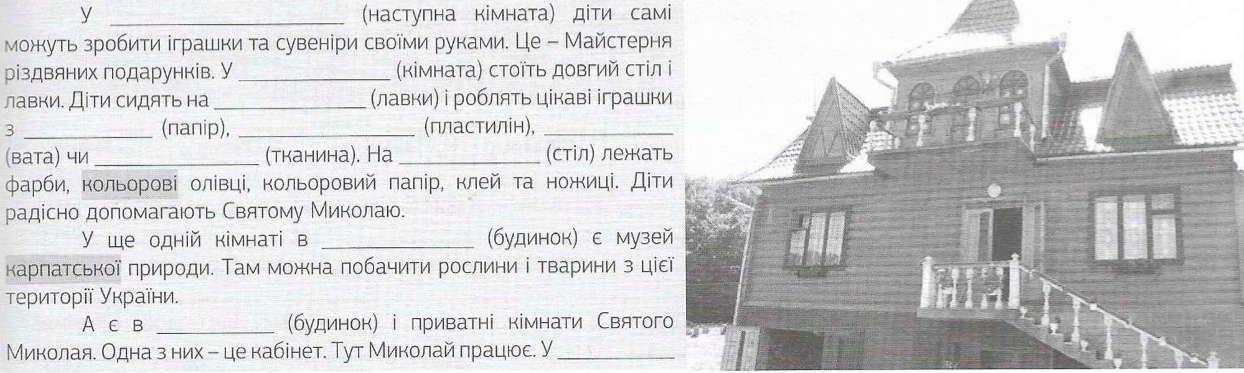
→ Sentences get longer and they are packed with new words. Here is the new vocabulary from a small extract of the text: наступна, самі, іграшки, своїми руками, майстерня, подарунків, лавки, папір, пластилін, вата, тканина, фарби, кольорові олівці, клей, ножиці, радісно, можна, рослини, тварини, приватні. A student should consult the dictionary a lot while doing this grammar exercise.
✅ So, if you feel that you are moving forward but it does not become easier, it does not mean that your level does not improve – it is just the design/curriculum of this course which is intended to grow pressure and confront you with more and more tricky challenges.
Vocabulary
The number of words they expect you to encounter and memorize is overwhelming. To my mind, they are much more numerous at the elementary level (green books) than at the intermediate one (yellow books).
If to count the words in the vocabulary part at the end of each unit, there are about 3000 of them in the student's book of the elementary level. It means approx. 250 words in each unit.
If you compare the vocabulary that a student is supposed to learn as a beginner, you will see a difference between "1000 and 1 words (A1)" by Ксенія Бородін and Оксана Туркевич and "Yabluko. Elementary Ukrainian". The vocabulary in the "1000 and 1 words" is more functional. However, it is fair to say that "1000 and 1 words" is for an A1 level, and "Yabluko" is for an A2 level.
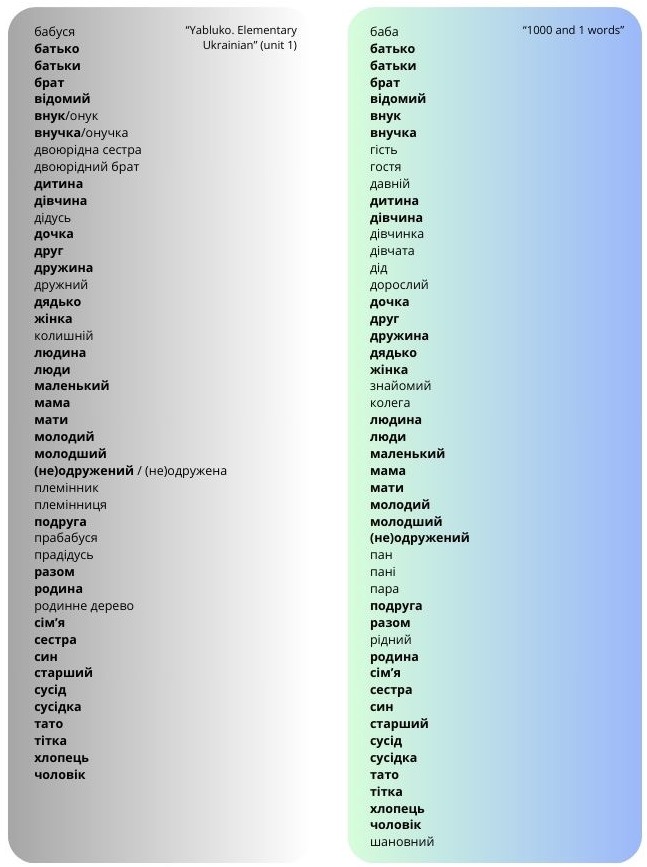
Moreover, they introduce emotional and spoken phrases at the very beginning of the course. Sometimes, they also provide dialectisms without noting that it is not a widely accepted Ukrainian equivalent but rather a Galician way of saying it (more about it below, in the part about culture). Such cases are not numerous but worth mentioning. For example,
Unit 2, Lesson 2.1: They give a word "ратуша" (from German – Rathaus) for a city hall. However, according to the encyclopedia, you can find them only on 15 cities in Ukraine in the West of Ukraine (and only three of them are located in the oblast centers). A more common name for a city council is "мерія", which you can find in any Ukrainian city or town.
Unit 4, Lesson 4.2: In the listening task, they give such phrases as – "сестричко" (a diminutive form of "сестра"), "ой", "То це...?" (a question starts with "то"), "І що...?" (using "i" to start a question), "ну". In Lesson 4.4 they also use emphatic "ж": "я ж кажу". Conjunction "і" is used unusually for a beginner: "Вони і мене запросили". "Ну що ж" is another example of "ж". "А ти не знаєш?" – a question with negation to sound polite and to express the idea of "If you happen to know..." "Що?!" is used in the emotional function to express surprise.
✅ So, you will have to select the vocabulary relevant to you personally and be ready to make your way through a thick forest of new words in each unit. The number of words is mind-blowing, however, you cannot ignore them and focus solely on the words that you need in your speech, because texts and auidos base on a whole variety of vocabulary, and you just have to look up every new word in the dictionary.
Grammar
"Yabluko" is very exhaustive on grammar, however, it might be overwhelming and discouraging to learn all the intricate details at once. I would prefer if they first gave the main and more general information, and the exceptions – second. That means, if you learn the prepositional case, at first, you need to remember that we add -і for singulars and -ах/-ях for plurals (and drill it with the words that follow this general rule), and only later, I would mention that sometimes you need to add -iї or -eї and change stem consonants (e.g. книГа/у книЗі).
✅ So, you need to analyze grammar tables and decide what the general rule is. And turn to exceptions and "particulars" only after you have drilled the general rule. However, it would be difficult to do it, since all the grammar exercises in the books are straight away based on all the endings with the exceptions. That's why I recommend making paper flashcards for your vocabulary, then deciding which word follows which rule and making packs with them (e.g. a pack "+і", a pack "+ії", a pack "+eї", a pack "stem changes", etc. – see this video with my explanation on how to do it) and after that drilling the vocabulary step by step: the general rule → the details. And only after that, start doing the exercises in the book to wrap everything up.
Listening
The listening tasks are often very fast and packed with vocabulary.
✅ So, always start with all the preparatory exercises aimed at making listening easier. Always listen for the information you need to complete the task, and not for every single word. Then, open the transcripts at the end of the book and analyse the texts: what words are new? Why haven't you understood something (a new word, unknown grammar, etc.)? After that, try to read out the texts together with the audio – it will immensely improve your speaking.
Texts
The texts are real-life, not artificial, and great for discussions, but they are often packed with grammar and advanced sentence structures, so they require a lot of work with a dictionary.
✅ Work with texts longer than you need to complete the text. Look up new words, find a subject and a predicate in the sentence, ask questions about the text, write a summary, retell it, etc.
Ukrainian Culture
There is a lot of content about the Ukrainian culture, however, they mostly focus on the culture of the Western parts, saying nothing about the east, south, north and centre of the country. Sometimes, the information is outdated, the facts are quite generalized and have more to do with wishful thinking than with reality. Anyway, it provides a good ground for discussion. And discussions are an invaluable tool for improving your speaking and listening. Here are a couple of examples:
Unit 3 is about common Ukrainians. Some data might be outdated or peculiar of the western region more. For example, according to the poll (see pp. 49-50), only 16% of Ukrainians go to church every week (I am afraid, it is not enough to say in "Yabluko" in Lesson 3.3, "У неділю українець ходить до церкви".
Unit 6, Lesson 6.3 is about Ukrainian Christmas traditions. However, what is introduced as all-Ukrainian customs varies quite a lot from region to region.
In Unit 8, in Lesson 8.5, they tell about Ukrainian holidays, – "...Щедрий вечір вісімнадцятого січня". However, they do not mention that it is only in the western regions where they call the evening before Epiphany (Водохреща) as "щедрий". In other regions, "Щедрий вечір" is about New Year's celebration, and the evening before Epiphany is called "Водохрещенський вечір/Хрещенський святвечір/Голодна кутя". And in other parts of Ukraine, except Galicia, they usually do not do anything particular on this day. So, it is a good chance to discuss how traditions differ from region to region.
In Unit 12, Lesson 12.1 they tell us that a flower pot is called "вазон". There is such a word but it is not as widely used as its equivalent "горщик". That is why I prefer to give my students the latter one, even if it is not the one they prefer in western regions.
Unit 12, Lesson 12.3 is about souvenirs from Ukraine. And it is another great opportunity to discuss the diversity of Ukrainian regions and to brainstorm souvenirs' ideas from all over Ukraine.
Tips for studying with Yabluko
It is better to find a teacher to guide you.
Get a notebook for grammar. Draw tables, use coloured highlighters, and note down exceptions and examples.
Get a notebook for words (write down new words with translation, examples and grammar peculiarities). Highlight key vocabulary and import it to Quizlet (or similar flashcard tools). (Be ready that, unfortunately, the authors of the course expect you to 'once and for all' remember the word you have met just once. So don't get frustrated when you need to come back to your vocabulary notebook many times to recall the meaning of something.) Divide words into parts, and single out the root. Write a chain of a noun, a verb, an adjective, etc., with the same root. Discover the etymology of a word.
As mentioned above, work with texts substantially.
Bring to automatism reading the audio scripts aloud.
Always do all the exercises in the workbook.
Keep a philosophical attitude towards your studying and progress. The course is not intended to give you a feeling "Oh, I can..." and tick it "Done". On the contrary, it constantly introduces you to new challenges, exposes you to your gaps and throws you into the deep – "Will you swim out?" So, not to get discouraged, focus on the most important – functional grammar and vocabulary in every unit, and create and complete a small project (an essay, a letter, a story, a menu, etc.) after each unit.
For teachers:
Help your students to select the most important stuff.
Simplify.
Make it more modern, and provide contemporary infographics.
Prepare extra material related to the topic of the unit, simple and doable.
Make Quizlet cards to drill the vocabulary.
On completion of the unit, run a test to expose the gaps and also, more importantly, to demonstrate to the student how much they have learned.
When you have finished the green books, it is advisable to continue with the yellow ones (intermediate level). The intermediate level of "Yabluko" helps you to polish your grammar. According to my feelings, yellow books include fewer words but they help to wrap up what was learned with the green books.
Conclusion
"Yabluko" is an exhaustive, grammar-focused, modern course ideal for serious learners. And it is the only detailed substantial Ukrainian course available on the market, so unfortunately, we do not have a lot to compare with.
P.S. What textbook to choose if you just start to learn Ukrainian?
"Yabluko" might be too challenging for you, if you just want to try the waters and get acquainted with Ukrainian. For that goal, I'd recommend:
Podorozhi.UA – very simple and basic, but engaging and doable, fits for self-studying
"Ukrainisch für Anfänger" (Vera Kolbina, Svitlana Sotnykova) – basic information about everything you need to know at the elementary/intermediate level; quite dryish but comprehensive and doable
"Beginner's Ukrainian" (Yuri Shevchuk) – simple, with lots of drills; quite dryish but efficient if you want to have tangible achievements at the elementary level